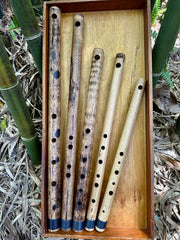
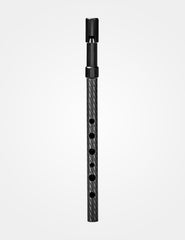

In 2008 fragments of flutes made from mammoth tusks were found in caves in Germany. In one of those caves, a broken flute in 12 pieces was found, made from the wing bone of a vulture by one of the earliest humans to arrive in Europe. In the same level of that fire pit, carved relics from mammoths were found. They are calling this flute, The Ice Age Flute and saying it is around 40,000 years old.
 \
\
A four holed flute made from a femur bone of a bear was found in a cave in France. Clay flutes and whistles have been dug up in the cornfields of the Mayan peoples of Guatemala. Here is an old whistle from Mayan Guatemala after the time of the Spanish arrival. The artist was a genius and on the carved side he made a Mayan head and tuning it upside down one can see it has turned into the head of a Spanish Conquistador.


From Africa to Asia the flute has left its mark.

Flutes made from the wing bones of ancient cranes were discovered in a 7,000 year old agricultural site in Henan, China. One can see by the reflecting light in the picture that the bones were very thin. And thus must have been played like the Andean Quena. Blown over the thin wall. One of those flutes (number 2 from top) had 5 holes and tuned like the 7th century Japanese Shakuhachi which tuning is found later in the Native American Kiowa Love Flute. The pentatonic scale played with rhythm sounds like Andean music. Did somebody have a flute when they crossed the Bearing Straights?
One wonders if the ancient Jiaju Crane flute made from the wing bone of ancient cranes may have come from a nearby Ancient Chinese Restaurant. : ) Clay pan pipes and human bone Quenas were found in the Andes.
Flutes have been found in tombs in Egypt and depicted on pyramid walls. And across the Mediterranean Sea we also find double flutes depicted on ancient Greek vases.


So where did the first flute come from? Was it someone's hands being blown into on a cold night in a cave after the fire went out? Was it later made from the clay of that cave, to reproduce the sound from the hands? Was it from a bone after a meal?

Was it first a Whistle made from the Ivory of a Mammoth tusk? An ocarina? A Clay or Bamboo Flute? An end blown flute? Side blown? A Pan Pipe? The answer my friend is blowing in the wind. But here are some of my thoughts.
In Ezekiel 28:13-19 in the Bible, it looks like the leading cherub of worship (who later had some real problems), was created with tambourines and pipes built into him. The workmanship of thy tabrets (Tambourines) and pipes was prepared in thee in the day which thou wast created. So music and flutes existed in a spirt realm before they got here. I have spoken to two people who have seen angels playing side blown and end blown flutes.
We also find in Genesis 4:21 that Jubal (the 7th generation after Adam and Eve) was the father of the Lyre, a harp and the Pipe, (Ugab, a Shepherd’s flute). Shepherds had a lot of time in the field and that's where King David learned to play his harp.
Aside from divine inspiration, we also see flutes in nature.
Here is an ancient natural Ocarina: Meet "Singing Stone".

Looks like ET's cousin.
“Singing Stone“ is one of nature’s oldest ocarinas. It is said these stones were made by prehistoric worms a long time ago.

Found in upper NY State.


Singing Stone was found on a cold wintery day around 1988. At Lodi Point in Lodi, NY on a Seneca Lake beach in upstate NY by Lauren Banner. Lauren describes the moment:
“The day I found Singing Stone was very cold and wintery. As I walked along the shore, I said the name of the lake in the Iroquois language. Someone had taught it to me years earlier. Gana de sege te karnio de, (not sure the spelling is right). I suddenly felt a warm spot. I walked forward and it got cold again. So I backed up and it got warm again. I backed way back and it got cold again, so there was about a three foot area that felt warm. Weird. But being a good earth lover, I stopped in the spot and started looking out across the lake, up in the sky, up the trees. What was it that I was supposed to pay attention to?
Finally I looked down at my feet and there was the face looking up at me.
I picked it up and blew into one of the holes. A beautiful clear tone came out. I rolled it around and tried the other holes. Each one a different tone. It had a hole going from top to bottom as well and played seven notes. It was about the size of an apricot and became a friend.”
Stones with worm holes.


Here is a picture of a "Clamarina" with one finger hole that I found in my yard in 2019. It has one finger hole and an end-blown V shaped notch. They say these clams are 55,000 years old. I live a few feet above an ancient ocean floor in Florida. After digging out a bit inside and sealing it with bees wax I was able to produce sound. Once again nature inspired a natural ocarina.

I found this coconut with an open hole which can make sound. This would have brought the ocarina to tropical lands. And eventually inspire the side blown flute in bamboo lands.
Here’s a thought. You live in a cave and it's winter. The fire is low and you are blowing warm air into your hands to keep them warm and you suddenly notice some fun sounds in the nice cave acoustics. Soon the other guests are trying and getting sound. Before you know it there are after dinner concerts and later one day the bone you are eating from, becomes a musical toy as you try to make sound too. Soon you are holding a primitive whistle made from some rock tools.
When cave dwellers moved into a cave, the best one had water. Clay helped to make that water into a reservoir and soon that clay made cups and bowls. From the discovery of sound coming out of a a cupped hand a clay whistle would soon have come. Making it longer and putting in finger holes you would have an early flute.

The natural holes on the left was made from ancient worms which may have inspired people to make ocarinas.

I suspect the earliest humans made whistles from clay for after dinner enjoyment, then the next morning the whistle was taken out to copy bird sounds with all the singing outside the cave. Later the whistle was used as a warning of coming wolves. Then one day when the wolves left and their mellowest pup stayed, the cave dwellers used the whistle to call their dog.
I visited a bird whistle workshop of some Indians in Guatemala in the mountains of Quetazltenango in the 1970's. They took a piece of clay from a big chunk and rolled it into a ball. Then they stuck their finger into it and with their other hand they formed a bird. The head and beak were made by pinching the top part of the clay ball. Their finger had also made the inside hollow. As the finger was removed, they flattened the tail over a flat stick making a mouth piece. They removed the stick and used it to open the air splitting chamber on the bottom and tuned it quickly as the clay was soft. Once they got sound they stopped moving the angle of the wind shaft. Then a round branch like a chop stick made the finger hole to get a 2 note whistle. Then it was fired in an adobe oven.
A Clay Whistle would have turned into the Ocarina by simply adding more finger holes. As the short and round clay ocarina was stretched you had the first flute.
Below is a picture of two Andean Quenas one made by an Ecuadoran Indian and the rustic one made by nature herself and found by my son Josiah during a bamboo harvest in 2001 in Florida. When the old bamboo fell to the ground it became the home of bull ants which made holes in it.
The top hole broke in half creating the Quena mouthpiece notch. Notice that the mouthpieces are almost identical.
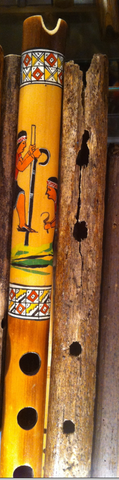
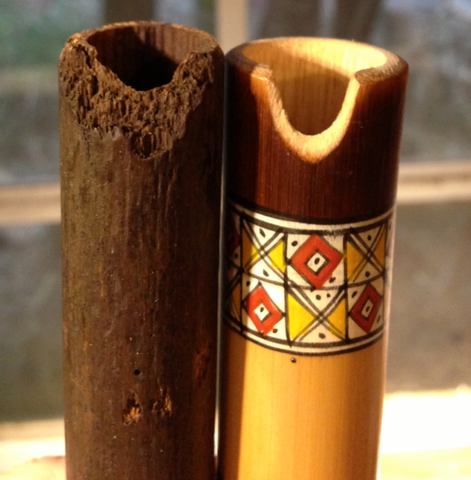
Here is another natural end blown mouthpiece next to a worked one.
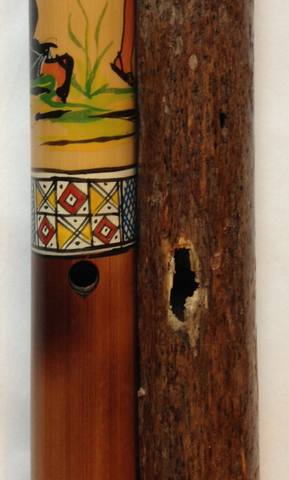
Notice above that even the back hole is there.

Next we see a Panpipe made by a Peruvian maker next to one of nature's own. A panpipe made from the Mud Dauber wasp which actually plays a same note as one in the panpipe next to it. The flat side of Nature's Panpipe fits perfect against the lower lip and chin. May this 3 layer natural Panpipe be the inspiration of this one?


Panpipes are played on every continent in the world. And are said to have been around for 4000 years. In the old Inca empire, Panpipes were used to send messages along the mountain plateaus. A message may have been, "It's a boy, the Prince is born".

Above is an old bone flute found in 6th century BC near the Dead Sea in Israel.

I have seen a bamboo culm growing in a grove with a perfect blow hole on it made by a bee.

I can imagine a scenario where wind is passing by a “natural bamboo flute” and a nearby tribe being spooked by its haunting sound until a visiting kid from the next village finds it playing in the wind. He stares at the blow hole, feels the wind passing causing sound and gets the idea to pull the old dry bamboo flute down and starts playing. Soon everybody in the tribe wants one and the flutes get perfected.
>I found an ancient obsidian arrow head that was thin which could have opened holes in cane that I found all over as I traveled Latin America. Having a Swiss Army Knife I used the Awl to open holes on the spot to make a flute.
From a hole in a coconut, a piece of clay or a bee hole in bamboo comes the flute to the tribe, the village the town and society. The side blown fife was found in China 3000 years ago.
Suddenly a flutemaker is making his living selling them at the local market and in time it is played in native bands. When a musician is very talented his playing inspires many to play flute. And flutes get made better.
From the plain fife the flute gets larger and more notes are placed in it. Soon with technology keys are placed and we have wooden recorders with pinki keys that morph into metal flutes with keys.
From blowing into cold hands in a cave, to trying to copy the sound in clay the whistle is born which likely becomes The Shepherds Flute, a for runner to the Penny Whistle which would have evolved into the Recorder.
The open hole coconut, a stone with hole and piece of bamboo with a bee hole would have morphed into the fife. In time it got larger and deeper with keys to play more notes. In the second half of the seventeenth century French flute maker Jacques Hotteterre modeled and improved many of the woodwinds of his day. Then came the amazing Boehm flute in 1847, which is the father of the modern flute. Theobald Boehm (1794-1881) was a Bavarian flute virtuoso who played at the royal court in Munich, Germany and changed the world with his concert silver flute.

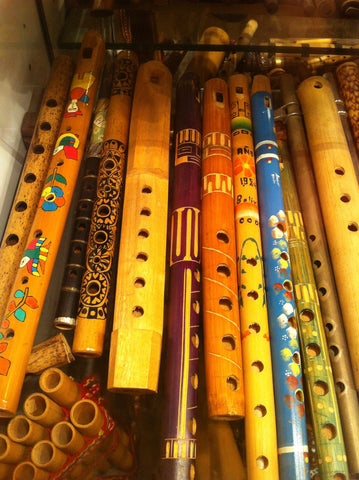
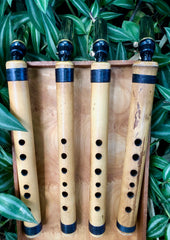
Alas, welcome to my office where you will find Bamboo Flutes from different cultures and the very cool Bamboo Sax.
Erik the flutemaker



I just got my first flute a few days ago and decided to do some research, this blog gave me more information than I hoped for! thank you so much!
Brilliant & interesting page – I didn’t know Ancient Egyptians used flutes – a cool fact for my Egyptian project at school. I just got my first flute yesterday and can now get a sound out of it yaay!
COOL!!!!!!!
i love it this has really helped me collect info for my school assignment
A very informative posting. Have enjoyed your website for years. Your humor and expertise in flutes is remarkable.